

Build a Useful Salon Trial for a New Grooming Tool
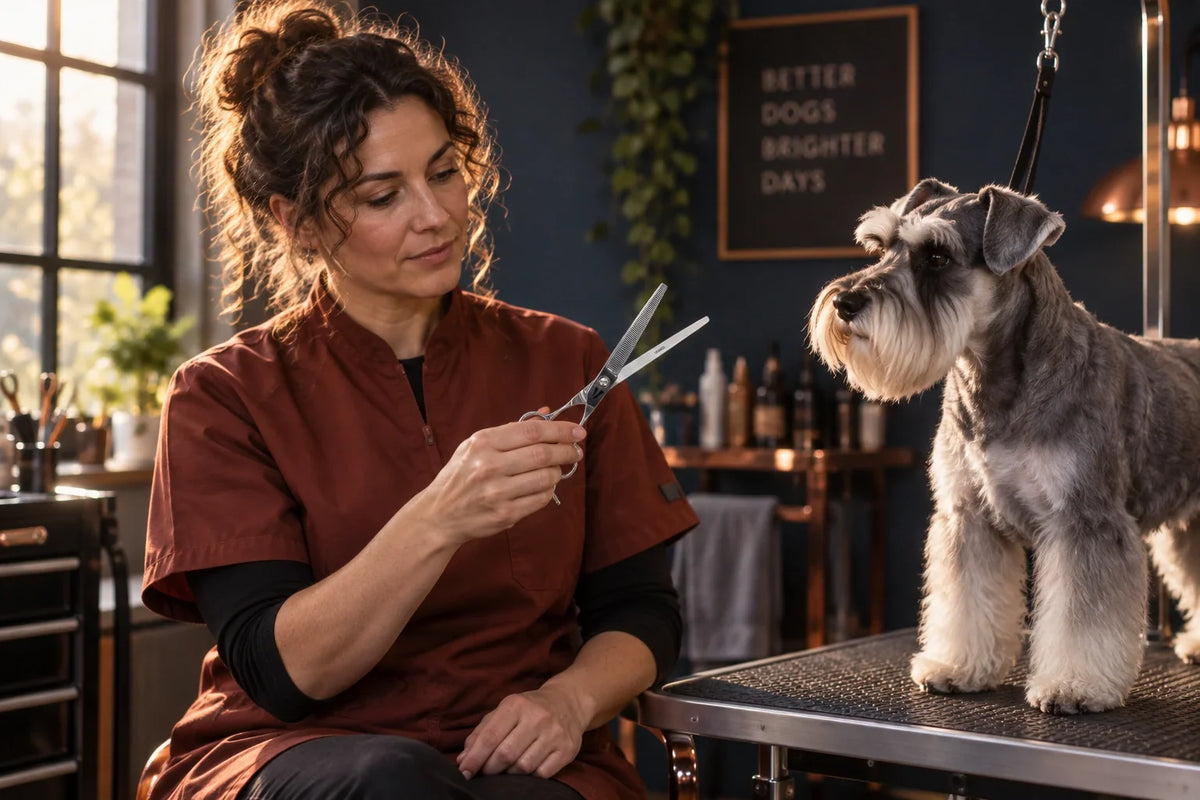
You try a new thinner on an easy coat, finish quickly and decide it has saved ten minutes. Then a colleague uses it on a very different dog and disagrees. Neither observation necessarily tells you what the tool contributed.
A small salon comparison can be useful without becoming a research project. The trick is to decide what you are comparing before a particularly good or bad appointment makes the decision for you.
Start with one job and one question
“Is this scissor better?” is too broad. “Does it reduce correction time on the leg finish we regularly produce, while meeting our usual finish standard?” gives you something observable.
Both tools must already be appropriate for the task, the groomer and the dog. Do not use a client appointment to test uncertain compatibility, an unfamiliar handling technique or equipment that needs servicing. Allow familiarisation before collecting times, and obtain the client's agreement to the normal grooming plan.
Keep the important comparisons together
NIST's experimental-design handbook explains blocking: organise comparisons within similar conditions so a nuisance variable, such as operator or time period, does not become confused with the treatment being compared. Randomisation can address other order effects. That is a formal design principle; a small salon audit usually cannot control all the differences between living dogs. Read NIST's explanation.
For your own working comparison, have the same groomer assess both suitable tools across comparable routine tasks. Avoid assigning every new-tool appointment to your fastest finisher and every existing-tool appointment to a trainee. Record coat condition, intended finish, preparation and any meaningful interruption.
A repeat client's next visit may offer useful context, but it is not an identical test: coat growth, maintenance, behaviour and the interval between appointments may have changed. Keep those differences visible.
Time the whole job that matters
| Record | Why it belongs in the comparison |
|---|---|
| Initial task time | Shows how long the first attempt took |
| Correction time | Prevents a fast first pass with extra rework looking like a saving |
| Tool changes and setup | Captures time moved into another part of the routine |
| Finish assessment | Checks the result against the same agreed visual references |
| Comfort, breaks and stopped work | Keeps welfare decisions visible rather than deleting inconvenient appointments |
Here is a hypothetical example. One method takes eight minutes initially and six minutes to correct; another takes ten minutes initially and two minutes to correct. The second method takes twelve minutes in total, versus fourteen. Looking only at the first attempt would produce the opposite conclusion.
Do not penalise a groomer for taking a necessary break or stopping. Note the reason and keep the appointment in your audit record, even when it is unsuitable for a simple timing comparison.
Agree what an acceptable finish looks like
Use a few relevant reference views and plain criteria: the intended outline, visible transition lines and any required correction before handover. Ask a second experienced groomer to assess the result where practical. They should apply the same criteria rather than simply stating a favourite tool.
If two assessors disagree, discuss the visible feature first. Different finishing expectations can swamp a small time difference. The disagreement may reveal a training need more valuable than the purchase decision.
Choose candidates for their actual role
The VUNRO 7-inch Precision Thinners have a different job from a straight cutting scissor. Select them for an appropriate blending task and evaluate that task; do not treat every scissor closure as equivalent.
For a guard comparison, first establish the complete mounting system. Our Universal Guard Comb Set fits specified standard-width A5 and D-Series #10, #15 and #30 base blades. Wide guards and trimmer guards are separate systems. A consistent checking comb helps keep the preparation and finish review comparable.
Make a modest decision from a small audit
You may learn that a tool earns its place on one common finish, needs more practice, or offers no useful advantage for your current work. That is enough. A handful of appointments cannot establish that a design is universally faster, safer or better for every coat.
Write down the decision, the conditions where it applies and what would make you review it. Then use the equipment where it has a clear purpose.
Sources and scope
NIST/SEMATECH e-Handbook: Randomized block designs. The timing example is invented arithmetic for illustration. This article proposes a practical salon audit, not a controlled trial of VUNRO products.
Keep learning
More from the Blade Blog

Separate a Dry Surface from a Dry Coat
Read the guide →
Check the Outline in Motion Before Making Another Cut
Read the guide →


